Study
At least 50% off from FlexSub
Subscribe Now
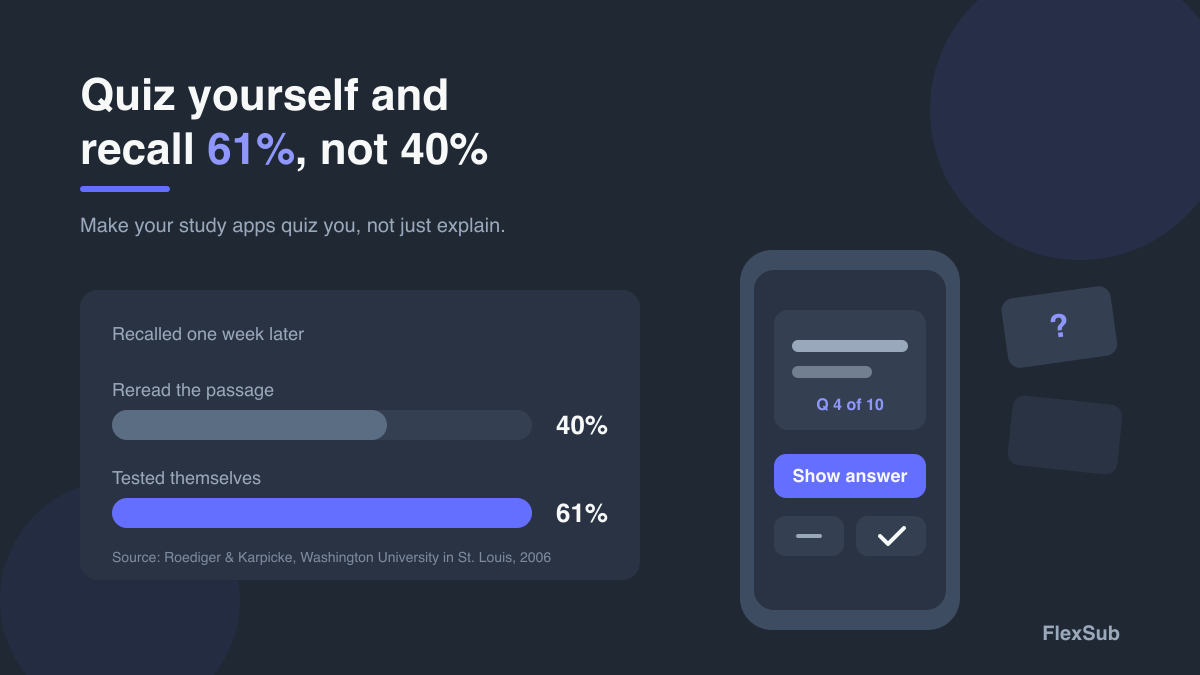
61% versus 40%. That's how much students remembered a week later when they tested themselves instead of rereading the same passage.
And it's exam season. If you're about to spend the next few weeks with a study app, an AI chatbot and a stack of notes, that gap matters more than which app you pick.
Here's the catch: most of us use study tools in the way that feels productive, not the way that actually sticks. The good news is that fixing it takes minutes, and you probably already pay for everything you need.
The 60-second version:
- Swap rereading for self-testing. It's the single biggest win.
- Make your AI tool quiz you, not write for you.
- Space your reviews out instead of cramming them into one night.
- Pay for study tools by the exam, not by the year.
- Don't pay full price for a tool you'll only need for a few weeks.
Here's how to do each one.
Almost everyone uses AI to study. Few feel taught how
AI is no longer a side tool for students. The Higher Education Policy Institute (HEPI) and Kortext surveyed 1,054 full-time UK undergraduates for their Student Generative AI Survey, published in March 2026. They found 95% now use AI in some form, and 94% use it to support assessed work.
But the same report found fewer than half of students feel adequately supported by their teaching staff when it comes to using AI well. Students said AI saves them time and helps them grasp difficult material, but many also worried it could weaken independent thinking and academic skills.
So the question isn't whether you use AI or a study app. It's whether you're using it in a way that makes you better at the exam, or just faster at feeling finished.
The 21-point gap most students ignore
Back in 2006, psychologists Henry Roediger and Jeffrey Karpicke at Washington University in St. Louis ran a simple experiment. College students read a short prose passage. One group kept restudying it; the other group took recall tests on it instead, with no feedback.
A week later, as the university reported at the time, the self-testing group recalled 61% of the passage. The restudy group recalled 40%.
Rereading feels easier, which is exactly why it fools you. Testing feels harder, which is exactly why it works. Every move below is built on that idea.
Do this today: close your notes and write down everything you remember about one topic. Then check what you missed. That's one study session done properly.
Turn your AI chatbot into a tough examiner
Most people ask an AI tool to explain or summarise. That's rereading with extra steps. Flip it around and make it test you instead.
Try prompts like these:
- "Ask me 10 exam-style questions on photosynthesis, one at a time. Don't give me the answer until I've tried."
- "Here are my lecture notes. Quiz me on the parts I'm most likely to forget."
- "Mark my answer like a strict examiner and tell me what a top answer would add."
You're still using the tool you already pay for. You're just making your brain do the work, which is the part that shows up on exam day.
Why one long night beats nothing, but five short ones beat both
Flashcard and study apps are built around spacing: seeing the same material again just as you're about to forget it. That only works if you open them little and often.
A simple routine for the weeks before an exam:
- 15 minutes a day on flashcards, every day, rather than two hours on Sunday.
- Make your own cards from past-paper mistakes, not just pre-made decks.
- Mix subjects in one session, so you practise picking the right method, not just repeating the last one.
If an app has been sitting unopened since last semester, this is the month to either use it like this or stop paying for it.
Are you paying for study apps in months you don't study?
Study tools are one of the easiest subscription leaks. You sign up during exams, then the plan quietly renews through the holidays.
Before you subscribe or renew, look at your exam timetable and work backwards:
- One exam block? A short plan that covers the next four weeks is usually enough.
- Full year of study? A longer plan for your main tool can cost less per month than paying monthly.
- Three apps doing the same job? Keep the one you actually open. A flashcard app, a writing helper and one AI tool cover most students.
Set a reminder for the day after your last exam to cancel anything you won't need until next term.
Don't pay the sticker price for a few weeks of revision
The last move is the price itself. The official monthly price isn't the only way to get most study and learning tools.
Services like FlexSub offer discounted plans across study, learning and productivity tools, in lengths from 27 days up to 12 months. That means you can match a plan to your exam block instead of committing to a full year, or lock in a longer plan for the tool you use every week.
The best study app isn't the one with the most features. It's the one that makes you prove what you know. Test yourself, space it out, and only pay for the weeks you're actually studying.
Getting set for exams? Browse FlexSub's study plans and find the tools you need for this exam block, for less.
Study
At least 50% off from FlexSub
Better, flexible and cheaper subscriptions for a wide range of services in just a click of a button.
Get started now