Language
At least 50% off from FlexSub
Subscribe Now
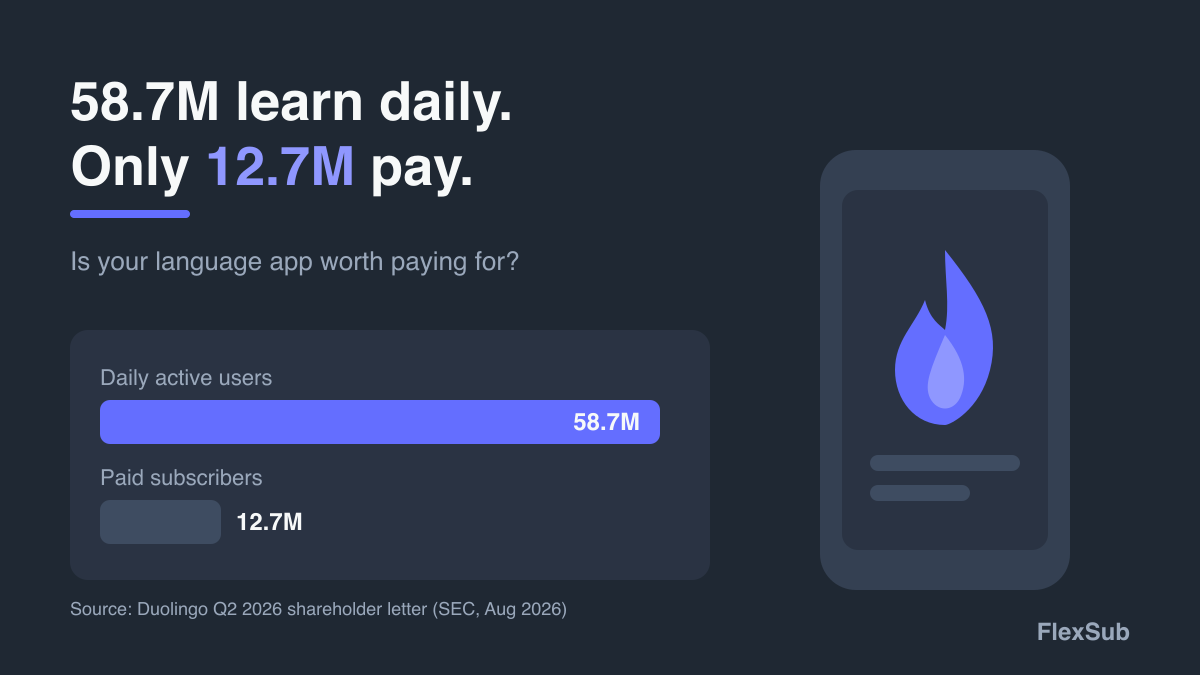
58.7 million people opened Duolingo every single day this spring. Only 12.7 million of them paid for it.
Those numbers come from Duolingo's own Q2 2026 shareholder letter, filed with the US SEC in August 2026. Daily users were up 23% on a year earlier, and paid subscribers up 17%. Language apps have never been more popular.
So here's the question you've probably asked yourself mid-lesson: is the paid plan actually worth it, or are you just paying to protect a streak? You'll know by the end of this article, and you'll have five ways to get far more out of whichever app you use.
The 60-second version:
- Work out your real cost per lesson before you renew.
- Pay for the features that make you speak, not the ones that just keep you tapping.
- Don't buy a year until you've survived a month.
- Pick an app for your goal, not for its mascot.
- Don't pay the sticker price.
Here's how to do each one.
Your streak isn't the same as progress
Here's an uncomfortable stat. In a 2024 Wall Street English survey of 1,000 UK language app users, 55% said their speaking confidence hadn't improved, and only 8% felt very confident in the language from using apps.
The same survey found people spend an average of 52 to 156 hours a year studying, and about 46% had paid for a language app. That's a lot of time and money for "I still freeze when someone talks back."
The fix isn't to quit. It's to measure the right thing. A streak tells you that you opened the app. It doesn't tell you that you can order dinner, follow a podcast or hold a two-minute chat.
Do this today: write down one real-world goal for the next 30 days ("introduce myself and ask three questions without notes"). Judge your app, free or paid, against that.
The cost-per-lesson maths nobody does
Paid plans feel expensive or cheap depending on how often you use them. So turn the price into a number you can actually judge.
Take what you pay a month and divide it by the lessons you really did last month. If you paid for a month and did 40 lessons, that's a small amount per lesson. If you did six, you paid a lot for each one, and the free tier would probably have covered you.
A simple rule:
- Practising most days? A paid plan can make sense, because you're using what you pay for.
- Practising once or twice a week? Stay free for now, or pay only in the months you're preparing for something (a trip, a test, a move).
Do this today: open your app's history, count last month's lessons, and do the division.
Pay for speaking, not for hearts
Not every paid feature helps you learn. Removing ads and unlimited mistakes make the app nicer to use. Features that make you produce the language make you better at it.
Duolingo's own shareholder letter says new Super subscribers now get access to Video Call, its AI conversation practice, with access extending to existing Super subscribers later in 2026. That's the kind of feature worth paying attention to, because speaking is exactly where the Wall Street English survey found app users felt weakest.
Whatever app you use, rank its paid features into two piles:
- "Makes me speak or listen": conversation practice, speaking exercises, listening to real speech.
- "Makes it comfier": no ads, unlimited retries, streak protection.
If everything you'd pay for sits in the second pile, you're paying for comfort, not progress. That can still be fine, but now it's a choice.
Don't buy a year until you've survived a month
Annual plans usually cost less per month than paying month by month. The catch is that you only save if you're still learning in month eight.
The same 2024 survey found nearly a third of users had abandoned their studies, and around 30% of those stopped because they felt anxious or overwhelmed. That's a lot of annual plans gathering dust.
So try a short plan first. If you're still practising after four weeks and the paid features are pulling their weight, a longer plan is a smart move. If you're not, you've lost one month, not twelve.
Do this today: if a renewal is coming up, put a reminder in your calendar two days before it so you decide, instead of it deciding for you.
Match the app to the job
Different apps shine at different things, and many people stack two when one would do. Before you pay for anything, be clear on what you need right now:
- Building a daily habit and vocabulary: a gamified app like Duolingo is hard to beat.
- Speaking with confidence: look for conversation practice, AI or human.
- Grammar for an exam or a move abroad: a structured course with clear lessons will serve you better than streaks.
Then pay for one app that fits the goal, and use free tools (podcasts, shows with subtitles, a language exchange) around it. One paid app you use beats three you feel guilty about.
Don't pay the sticker price
Once you know you'll use it, the last move is to stop overpaying for it.
- Match the plan length to your goal. Prepping for a trip in eight weeks? Pay for eight weeks. Learning for life? A longer plan usually works out cheaper per month.
- Compare sellers. FlexSub offers discounted plans for a range of language apps, in lengths from 27 days up to 12 months, so you can pay for exactly the stretch you're learning.
Millions of people are learning a language on their phone right now. The ones who get fluent aren't the ones paying the most. They're the ones paying for the right features, for the right length of time, and actually opening their mouths.
Ready to make your next month of practice count? Browse FlexSub's language learning plans and pick the length that fits your goal.
Language
At least 50% off from FlexSub
Better, flexible and cheaper subscriptions for a wide range of services in just a click of a button.
Get started now